Skip to product information
1 of 21

煎茶 中国茶 台湾茶向け 日本製急須/茶壺専門店 東山堂

Tokoname ware Yamada Tozan the 3rd seaweed pattern teapot B 150ml

Tokoname ware Yamada Tozan the 3rd seaweed pattern teapot B 150ml

Regular price ¥24,200 JPY
Regular price Sale price ¥24,200 JPY
Sale Sold out
Taxes included. Shipping calculated at checkout.
This teapot, crafted by Yamada Tozan the 3rd, represents a convergence of two distinct traditions: the art of teapot-making—which originated in China—and the seaweed pattern technique, nurtured in Tokoname.


The piece features a form rooted in the lineage of Chinese teaware, embellished with natural patterns created using seaweed. It serves both as a functional tool for brewing tea and as an object of aesthetic pleasure, inviting one to admire the intricate patterns adorning its surface.


(Biography of the Third-Generation Yamada Tozan)

Born in 1946 in Handa City, Aichi Prefecture.

In 1973, while working in the field of architecture, he began learning the arts of the potter’s wheel and glazing from his predecessor, the second-generation Tozan.

In 2000, he succeeded to the name "Tozan."

He is a licensed First-Class Architect and a Professional Engineer (Construction Division).


The first-generation Yamada Tozan was the younger brother of the first-generation Yamada Jozan and a prominent potter in Tokoname. The Yamada family were originally farmers; in the early Meiji era (late 19th century), the elder brother, Jozan, became a potter and learned the techniques for crafting red clay teapots—a method introduced to Tokoname in 1878 by Jin Shiheng, a potter from Yixing, China.


His younger brother, Tozan—born significantly later—began by assisting his brother with teapot production before eventually establishing his own independent practice. The first-generation Tozan created a variety of items, including teapots, tea bowls, and charcoal braziers.


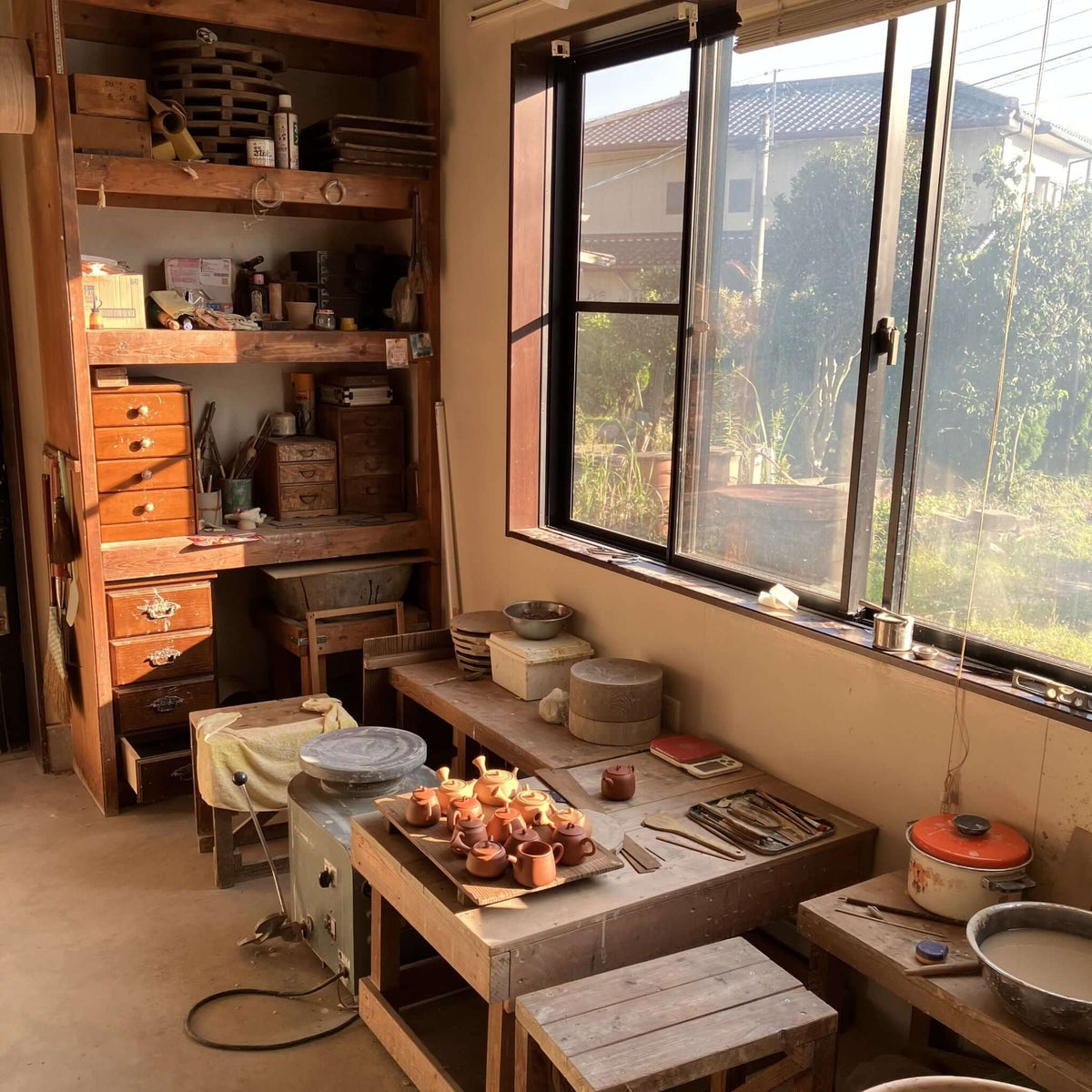
The third-generation Yamada Tozan carries on the traditional techniques for crafting red clay teapots designed for Chinese tea. He continues to use the same wooden tools—such as shaping sticks, pedestals, and boxes—that were employed by his predecessors. Observing his process, one is struck by how few tools are actually required to create these teapots.


The primary tools used in the crafting process are those shown in the accompanying photograph: a wooden pedestal, a stick with a pointed tip, and a stick with a rounded, protruding end. Since most of the work is done by the potter’s own hands, few tools are required—the hands themselves are the finest tools of all.


This teapot, designed for use with Chinese tea, incorporates seaweed pattern - a traditional technique unique to Tokoname. It represents a harmony between different craft traditions, brought together within a single vessel.


Seaweed pattern: A Tokoname Tradition Since the Edo Period

Seaweed pattern is a technique in which seaweed is placed upon or wrapped around the surface of a piece of pottery before it is fired, leaving behind a distinct pattern. Rather than being painted on with a brush, the patterns emerge as the salts and other minerals within the seaweed react with the clay body during the firing process.


The origins of this technique date back to the late Edo period. During the Tenpo era (1830–1844), Ina Chōza the 2nd developed a style known as fire-colored ware, which utilized a clay that fired to a white finish, decorated with dried seaweed. This creative use of materials—fitting for Tokoname, a pottery-producing region facing the sea—has been passed down to the seaweed pattern technique we see today.


Creating Nuance Through Seaweed Varieties

Yamada Tōzan the 3rd creates depth and shading in his seaweed patterns by carefully selecting different seaweed—some with higher salt content, others with less.


It is not merely a matter of placing seaweed on the piece and leaving the rest to the kiln; the potter must discern the unique properties of each material to draw out the full character of the pattern. This thoughtful approach adds depth to the lines and tonal variations of the seaweed pattern.


The charm of this teapot lies in the intersection of natural spontaneity and the potter’s deliberate intent. As you hold the piece and turn it in your hands, take your time to enjoy the patterns that unfold across its surface.


The teapots crafted by Yamada Tōzan the 3rd often follow the traditional forms of Chinese-style teapots. Yet, even when the overall shape remains consistent, the subtle details, textures, and atmosphere of each piece reveal the personal taste and creative vision of the maker.


The teapots crafted by Yamada Tōzan the 3rd possess a gentle quality, evoking the unhurried pace of life found in mainland China. Their aesthetic is closer to that of pre-modern Chinese teapots than to the contemporary style of Tokoname-ware teapots.


Potter: Yamada Tōzan the 3rd (Tokoname-ware)

Forming Method: Wheel-thrown

Firing: Electric kiln

Dimensions: Total length 13.5 cm (including handle and spout); body (widest point) 8.5 cm; height 5 cm

Capacity: 150 ml (to the brim); 120 ml (practical capacity)

Weight: Approx. 151 g

Packaging: Paper box

Notes: As these are handmade, each piece may vary slightly. The fit between the lid and the body is excellent; covering the hole in the lid will stop the flow of water.


*Tokoname Ware

Tokoname-yaki refers to pottery produced in the city of Tokoname, Aichi Prefecture. During the Middle Ages, it was Japan’s largest center for ceramic production, turning out not only everyday items like plates, bowls, and basins, but also large-scale vessels such as jars and urns.


From the end of the Edo period (around 1858), the region began producing red clay tea sets and sake vessels. By the mid-Showa period (around 1962), specialized electric kiln technology for red clay ware had been established. Tokoname red clay teapots are fired at approximately 1100°C; the clay is better suited for electric kilns—which operate at slightly lower temperatures—than for traditional wood-fired kilns, which reach higher temperatures of 1200–1300°C.


Millions of years ago, the Tokoname region lay at the bottom of an ancient body of water known as Lake Tōkai. As a result, the area contains fine-grained clay—such as the red clay used for these teapots—that is exceptionally well-suited for crafting such vessels.


Tokoname possesses a concentration of the specialized skills required for crafting teapots—such as advanced forming techniques and a process known as "suriawase" (precision grinding), which ensures that a teapot’s lid and body fit together seamlessly. It is the largest production center for teapots in Japan.

Low stock: 1 left

View full details

FAQ

Which type of of tea can I brew with the teapot?

It can be used for any type of tea. However, unglazed pottery is more likely to absorb the flavor of the tea leaves. By using different tea utensils for each type of tea, you can enjoy the flavor of the tea to the fullest.

For example, in the case of Japanese tea, sencha, fukamushicha, genmaicha, and gyokuro are all in the same family, but since hojicha has a strong roasted aroma, we recommend using a different tea utensil.

However, glazed pottery or porcelain tea utensils do not absorb the flavor of the tea leaves, so they are suitable for brewing various types of tea.

How do you wash a teapot?

Please wash the teapot with water, without using detergent. Ceramic teapots easily absorb detergent ingredients, which can affect the flavor of the tea.

Tea leaves remaining in the teapot are the main cause of tea stains. After brewing tea, we recommend removing the tea leaves once they have cooled and rinsing them with water.

Moisture remaining in the teapot can cause mold. Turning the teapot upside down will help it dry faster.

We do not recommend washing it in the dishwasher. Please wash by hand.

Can I remove tea stains from a teapot?

Here's how to remove tea stains.

1. In a bowl or pot, mix 24g of baking soda with 1 liter of water at 30-40°C.

*Do not use aluminum or Teflon-coated pots as they will react with baking soda.

2. Leave the teapot in the water mentioned in step 1 for 30-60 minutes.

3. Wipe off the tea stains with a soft sponge or cotton swab. Do not use hard sponges or brushes.

4. Rinse the teapot with water.

5. Thoroughly dry the teapot.

*Baking soda water may irritate your hands, so wear rubber gloves.

Can I return the product?

We do not accept returns unless the product is damaged when the package arrives.

Each tea utensil is slightly different and may have slight distortions or scratches. Please check the images posted on our online shop in advance.

If you have any questions about the detailed condition of the product, please feel free to contact us. We can send you additional images and videos of the product.

Do you ship internationally?

We can ship to the following countries:

China, Hong Kong, Macau, Taiwan, South Korea, Singapore, Malaysia, Indonesia, Thailand, Vietnam, Philippines

Are the goods antiques or second-hand goods?

All the products in the shop are new. We sell products produced by potters and kilns in Japan.